
Dholera Smart Water Grid Project Uses IoT & AI to Transform Water Management
Dholera Smart City is deploying an advanced Smart Water Grid that integrates IoT sensors and AI analytics to improve water distribution, reduce leaks, and optimize usage across residential and industrial sectors.
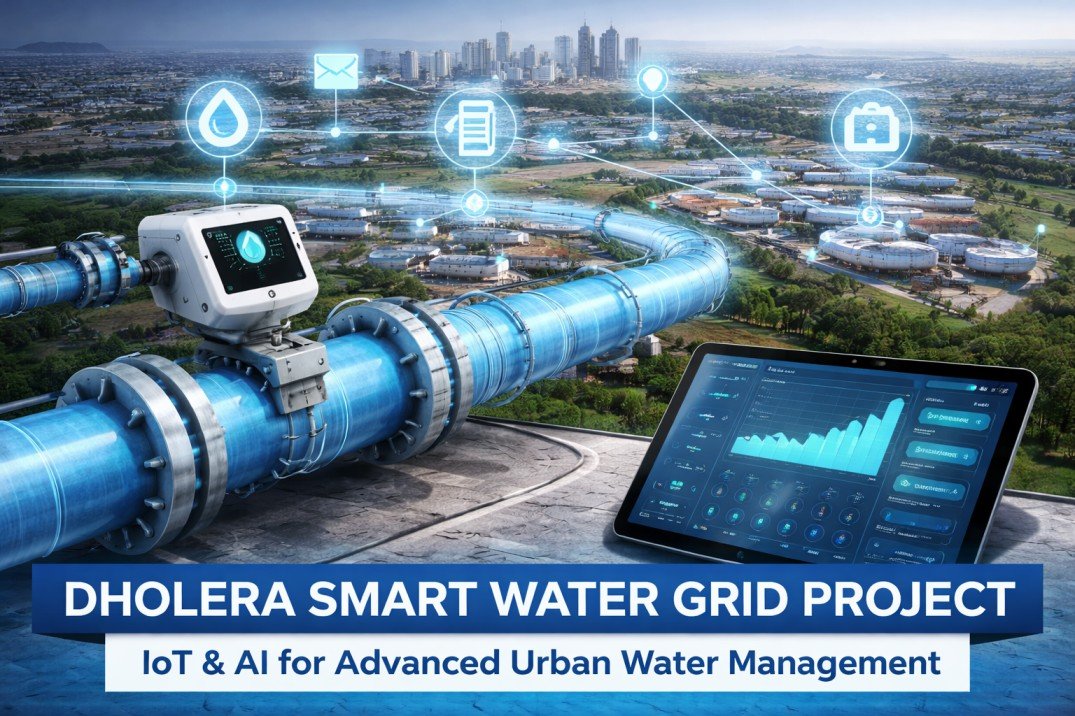
The Dholera Special Investment Region (SIR) is moving forward with an ambitious Smart Water Grid Project, aimed at reinventing urban water management through cutting-edge technology. The initiative combines Internet of Things (IoT) sensors, artificial intelligence (AI), and advanced data analytics to monitor, manage, and optimize water distribution for both residential communities and industrial users.
At the core of the project is a city-wide network of IoT sensors installed across water pipelines, reservoirs, pumping stations, and consumer endpoints. These sensors continuously collect real-time data on flow rates, pressure levels, water quality parameters, and consumption patterns. The data is then processed by AI-driven analytics platforms that detect anomalies, predict leaks, and recommend adjustments to reduce wastage and improve service reliability.
One of the key goals of the Smart Water Grid is leak detection and reduction. Unplanned pipeline leaks and losses are a concern in many urban centres, and Dholera’s system uses machine learning algorithms to flag aberrations in flow behaviour that may indicate a hidden break or inefficiency. This allows operations teams to intervene early, limiting water loss and reducing the need for costly repairs.
In addition to safeguarding supply lines, the Smart Water Grid supports demand forecasting and optimized distribution. AI models analyse historical and real-time usage data to predict daily and seasonal water needs, enabling utilities to adjust supply schedules and reservoir levels proactively. This is particularly valuable in a mixed residential-industrial environment like Dholera where demand can fluctuate widely.
The system also offers consumer-level insights through digital dashboards and mobile applications. Residents and businesses can monitor their own water usage, receive alerts about unusual consumption, and access recommendations for efficient practices. This transparency is expected to encourage greater water conservation and community engagement.
The Dholera authority has partnered with technology providers and academic research teams to ensure the platform remains scalable, secure, and adaptable as the city grows. Officials say that the Smart Water Grid is aligned with Dholera’s broader vision of a technology-enabled, sustainable smart city, where utilities are managed in real-time with minimal manual intervention.
With smart infrastructure like the water grid, Dholera aims to set new benchmarks for urban resource management in India. As the smart city expands and industrial activity increases, innovative systems like this will play a crucial role in ensuring resilient, efficient, and environmentally responsible utility services.